Is Your Website Quietly Draining Your Paid Media Budget?
Written by Anastasija Fruehling, Account Associate
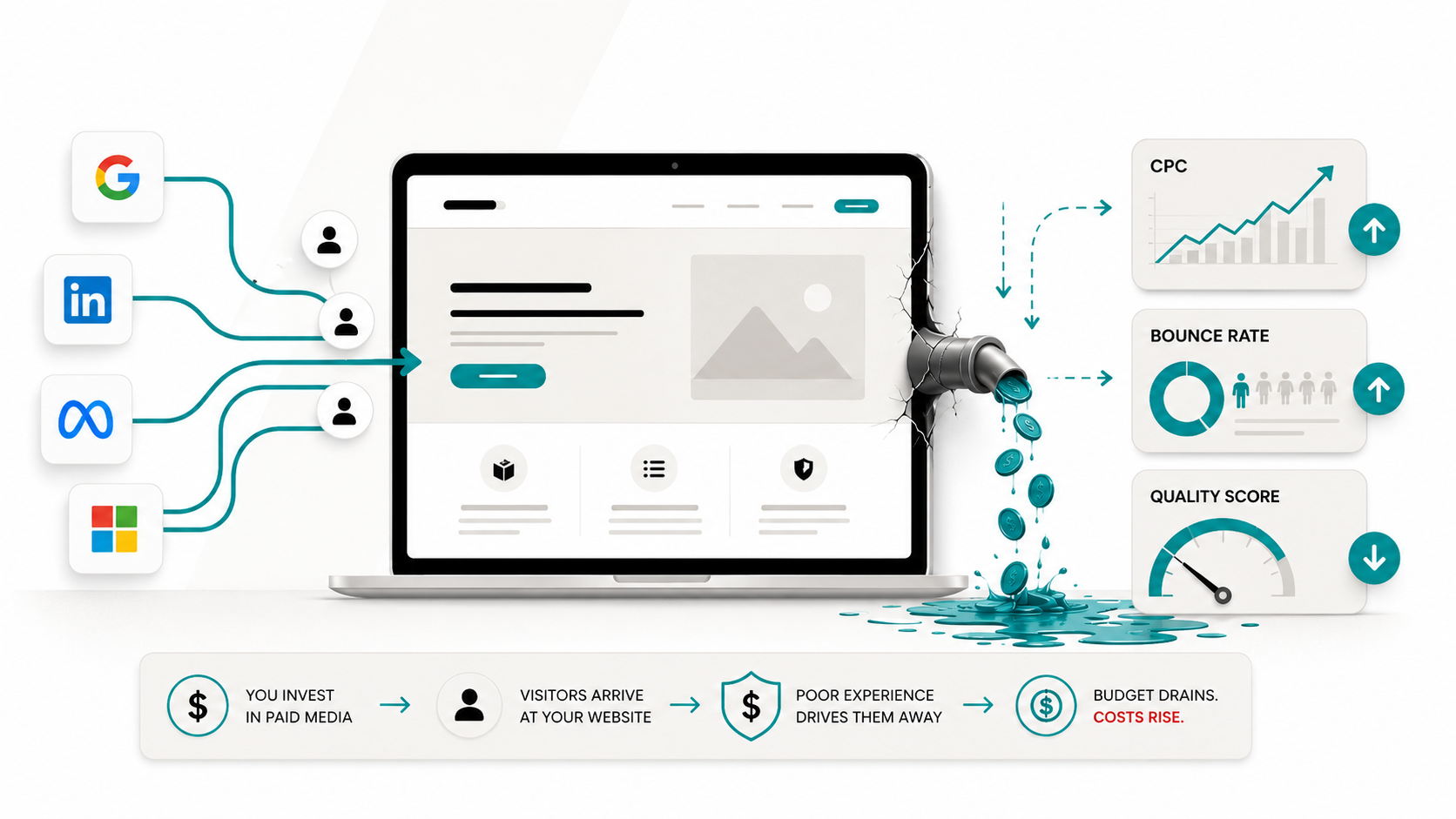
Running paid media is expensive, and when CPL climbs or conversion rates drop, most B2B teams do exactly what you'd expect: they look at the ads. New creative, adjusted bids, different audience targeting. Sometimes that fixes it, but a lot of the time the problem isn't the campaign at all. It's what happens after someone clicks.
Google, LinkedIn, and Meta all evaluate the quality of where you send paid traffic, and a weak website doesn't just hurt conversions after the click. It raises what you pay per click, lowers your ad placement, and creates a compounding cost problem that no B2B paid media strategy can fully overcome without addressing the foundation underneath it. Every major paid platform has destination quality built into its auction logic, and all of them charge more when advertisers send users to poor experiences.
This post breaks down the specific mechanisms that connect website quality to paid media costs, including the ones most teams never think to investigate. By the end, you'll have a clear picture of what to audit, what to fix, and why doing it before scaling spend is the highest-leverage move available.
Key Takeaways
- Quality Score penalizes poor landing pages by raising your CPC significantly for the same auction position
- B2B buyers validate your brand organically after clicking your ad, and your SEO footprint determines whether they actually convert
- AEO gaps let competitors get cited by AI tools like ChatGPT and Perplexity before you even enter the picture
- Form friction wastes paid clicks through drop-off at every unnecessary step in the conversion path
- High bounce rates from paid traffic compound over time by feeding back into Google's quality signals and raising your future CPCs
- Technical factors including page speed, schema markup, and heading structure directly affect both organic rankings and paid performance
Why Paid Platforms Care About Your Website
When you run a paid campaign, you're not just competing on bid. You're being evaluated on what comes after the click, and that evaluation has a direct dollar value attached to it every time your ad enters an auction. Google, LinkedIn, and Meta all measure post-click experience because their revenue depends on users finding ads useful, and an ad that sends someone to a slow, irrelevant, or confusing page is, from the platform's perspective, a bad result that gets penalized.
The scoring systems you know about
Google has Quality Score, LinkedIn has Relevance Score, and Meta has ad quality rankings, all operating on the same underlying principle: a better destination experience means lower costs and better placement. Our paid media management team tracks these scores across every campaign we run, because a single point change in Quality Score on a high-volume keyword can represent thousands of dollars in monthly savings or losses. The scores aren't just reporting metrics. They're levers that your website condition directly controls.
The signal most teams miss
Beyond the formal scores, every major paid platform monitors what users do after they click, and high bounce rates from your paid traffic teach the algorithm that your ads lead somewhere users don't want to be. That signal doesn't just affect a single campaign. It compounds over time and raises costs across your entire account, which is part of why platform-reported metrics alone don't always surface the full picture when you're diagnosing underperformance.
Quality Score: The Hidden Tax on a Poor Website
Quality Score is a 1 to 10 rating Google assigns to your keywords, built from three components: expected click-through rate, ad relevance, and landing page experience. Most paid search teams pay close attention to the first two and treat landing page experience as someone else's problem. That's a costly mistake, because landing page experience is where your website either helps your campaigns or quietly works against them every single day.
What Google actually evaluates on your landing page
Google evaluates landing page experience based on three factors: whether the page content is relevant to the search query, how trustworthy and transparent the site appears to users, and how easy the page is to navigate and use. A slow page, a confusing layout, or a page that doesn't deliver on what the ad promised will score below average. That score carries a real dollar cost that's applied every time your ad enters an auction, and the lower it is, the more you pay for the same placement.
What a low Quality Score costs per click
The cost difference between a strong and a weak Quality Score is larger than most teams expect. According to 2026 Google Ads benchmark data, accounts with Quality Scores of 8 or above pay CPCs 37 percent below the industry median, while accounts scoring 4 or below pay 64 percent more. That's not a marginal gap. A competitor with a better website can outrank you while paying significantly less per click, not because their bid is higher, but because their landing page experience is stronger.
Running the numbers
To put that in real terms: if you're spending $15,000 a month on paid search and your core keywords are sitting at a Quality Score of 4, you could be paying $9,600 a month more than a competitor with a score of 8. That's over $115,000 a year in recoverable waste tied directly to your website and landing page quality. Running a Quality Score audit across your core keywords is one of the fastest ways to surface where the biggest cost leaks are hiding.
Our paid media management services include Quality Score analysis as a standard part of every campaign review, because it's one of the most impactful levers available before adding a single dollar to the budget.
How Your SEO Footprint Affects Paid Conversion
Organic search and paid search feel like separate channels on a marketing plan, but for the B2B buyer on the other side of your ads, they're part of the same journey. Your organic presence is actively involved in whether your paid clicks convert, and most teams don't account for that when they're diagnosing a CPL problem. Fixing paid while ignoring organic is like patching one end of a leaky pipe.
What B2B buyers actually do before they convert
B2B buyers almost never convert on first touch, and even after clicking your paid ad, most of them will Google your company name, check your blog, look for reviews, and scan case studies before submitting anything. This is standard behavior across B2B buying cycles, not a niche pattern, and it means the content and credibility of your website are part of the conversion equation every single time a paid click lands. If your site has thin content, an inactive blog, or no visible proof points, that research moment turns into a doubt moment. You can see what an integrated content and paid approach looks like in our Databricks case study, which shows how organic and paid working in tandem drives meaningful pipeline results.
The brand search validation moment
Here is where paid clicks and organic presence physically collide for every B2B buyer. A prospect clicks your ad and, before submitting anything, searches your company name to validate who you are and whether you can be trusted with their budget. Strong organic presence with authoritative content and consistent rankings validates the decision they were already leaning toward, while a weak or absent footprint creates hesitation right at the conversion point you paid to create. You paid for that click, and your organic footprint decides what happens next.
Double listings and the multiplier effect
When you rank organically for the same keyword you're bidding on, you appear twice on the same results page, which consistently lifts total click-through rate and reduces the cost burden on paid campaigns. Paid and organic stop competing for budget allocation and start amplifying the same message to the same audience. Our SEO and AEO services are built around this full-funnel relationship, making sure organic presence actively supports the campaigns generating paid traffic rather than operating as a separate workstream.
AEO: The New Competitive Layer in B2B Paid Media
There's a shift happening in how B2B buyers start their research, and most paid media strategies haven't accounted for it yet. Answer engine optimization is changing who wins buyer attention before the ad auction even begins, and the brands building for it now are compounding an advantage that will become harder to close over time.
What is AEO and how is it different from SEO?
SEO (search engine optimization) focuses on ranking in traditional search results like Google. AEO (answer engine optimization) focuses on being cited as a direct answer by AI tools including ChatGPT, Perplexity, and Google AI Overviews. Where SEO earns a link in the results, AEO earns a mention in the answer itself, and that distinction is increasingly important as B2B buyers start research with AI tools before ever reaching a traditional search results page. For a detailed breakdown of how both strategies work together, our SEO/AEO page covers the question in depth.
How an AEO gap affects paid media
Picture a B2B buyer evaluating marketing agencies who asks Perplexity which ones specialize in SaaS paid media. Your competitor gets cited as a recommended option and you don't show up at all, so that buyer arrives at your paid ad already leaning toward someone else. You paid for that click, but you didn't pay for the competitive disadvantage that came before it. As AI search becomes more embedded in the B2B research process, this gap widens for every brand that hasn't built AEO into its overall strategy.
What gets you cited by AI search
The signals that earn AI citations overlap heavily with established SEO best practices: clear, direct answers to common buyer questions, FAQ sections with schema markup, proper heading structure that AI tools can parse, authoritative content with genuine depth across your core topics, and consistent internal linking that signals topical expertise. This overlap isn't a coincidence. A well-structured site built for traditional search is already better positioned for AI search, which is exactly why both strategies should be built together rather than treated as sequential projects.
The Technical SEO Factors That Directly Affect Paid Performance
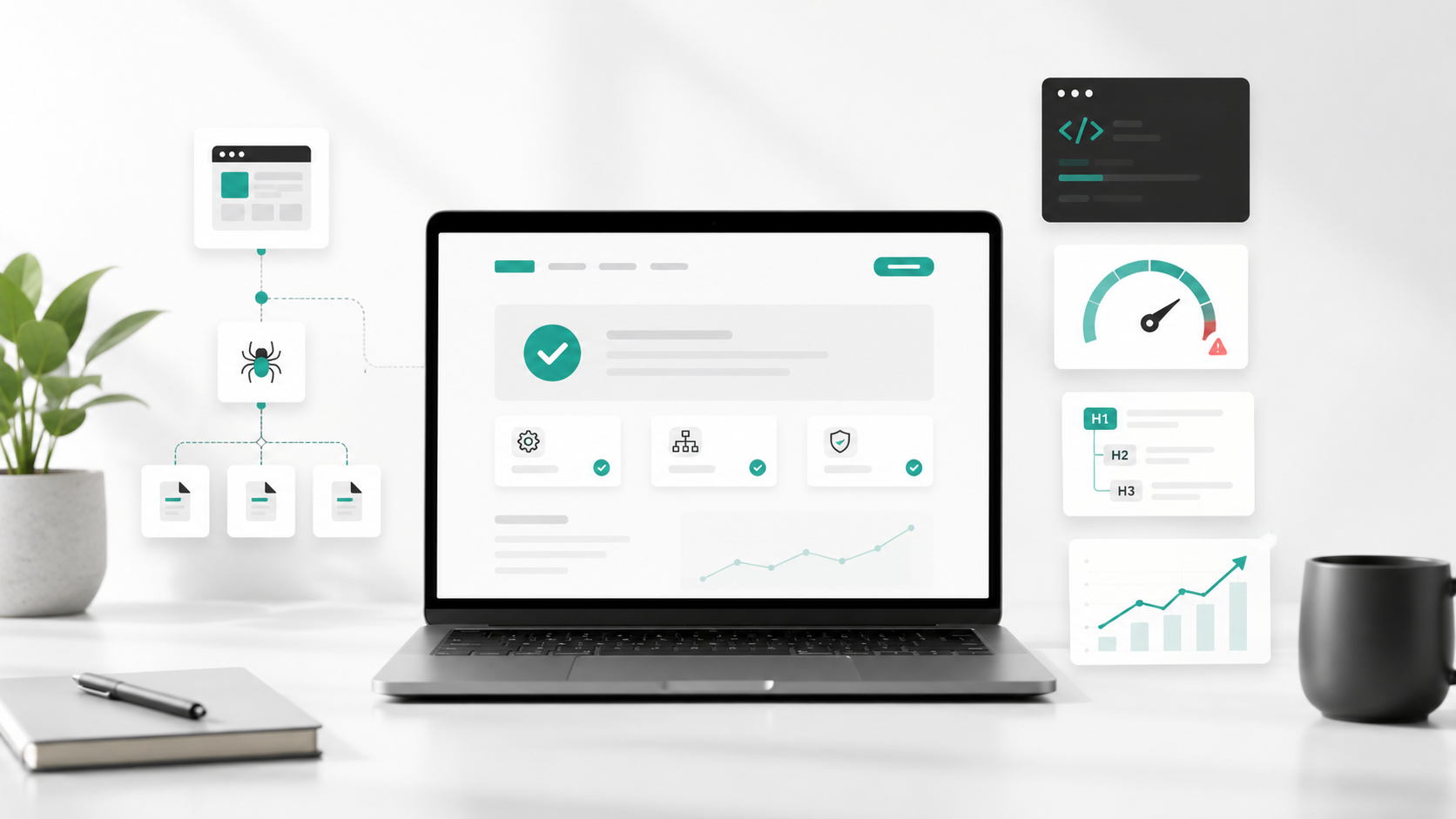
The technical condition of your website sends quality signals that your paid campaigns depend on, and these factors usually sit with a different team than the one managing paid media. That structural separation is the problem. Technical SEO health affects both organic authority and the quality scores your paid campaigns generate, and treating them as independent workstreams means neither side gets a complete picture of what's happening.
Crawlability and indexing
If Googlebot can't crawl and properly index your pages, those pages carry no SEO authority and can't support the performance of your paid landing pages. Broken internal links, misconfigured robots.txt files, missing XML sitemaps, and redirect chains all create indexing problems that build quietly over time without anyone noticing the impact. A site with unresolved crawl errors can't grow the organic footprint that paid campaigns need to convert the traffic they generate.
Schema markup and structured data
Schema markup tells search engines and AI tools exactly what your content is, enabling rich results in traditional search, improving your chances of appearing in Google AI Overviews, and making it easier for AI tools to cite you as an authoritative source. For B2B SaaS companies, adding schema to service pages, case studies, FAQ sections, and blog posts is one of the best technical investments available relative to the effort it requires. It's also a foundational step for AEO, since AI tools preferentially surface content that is clearly structured and easy to parse.
Heading structure and content chunkability
A clear H1, H2, H3 hierarchy simultaneously serves three audiences: human readers who scan before they commit to reading, search crawlers that use heading structure to understand page content and context, and AI tools that extract direct answers from well-organized sections to surface in summaries and citations. Poor heading structure is one of the most common issues on B2B SaaS websites, and it's also one of the fastest things to fix with a focused content audit. The payoff flows immediately into organic rankings, AEO visibility, and the quality signals your paid landing pages send.
Core Web Vitals and page speed
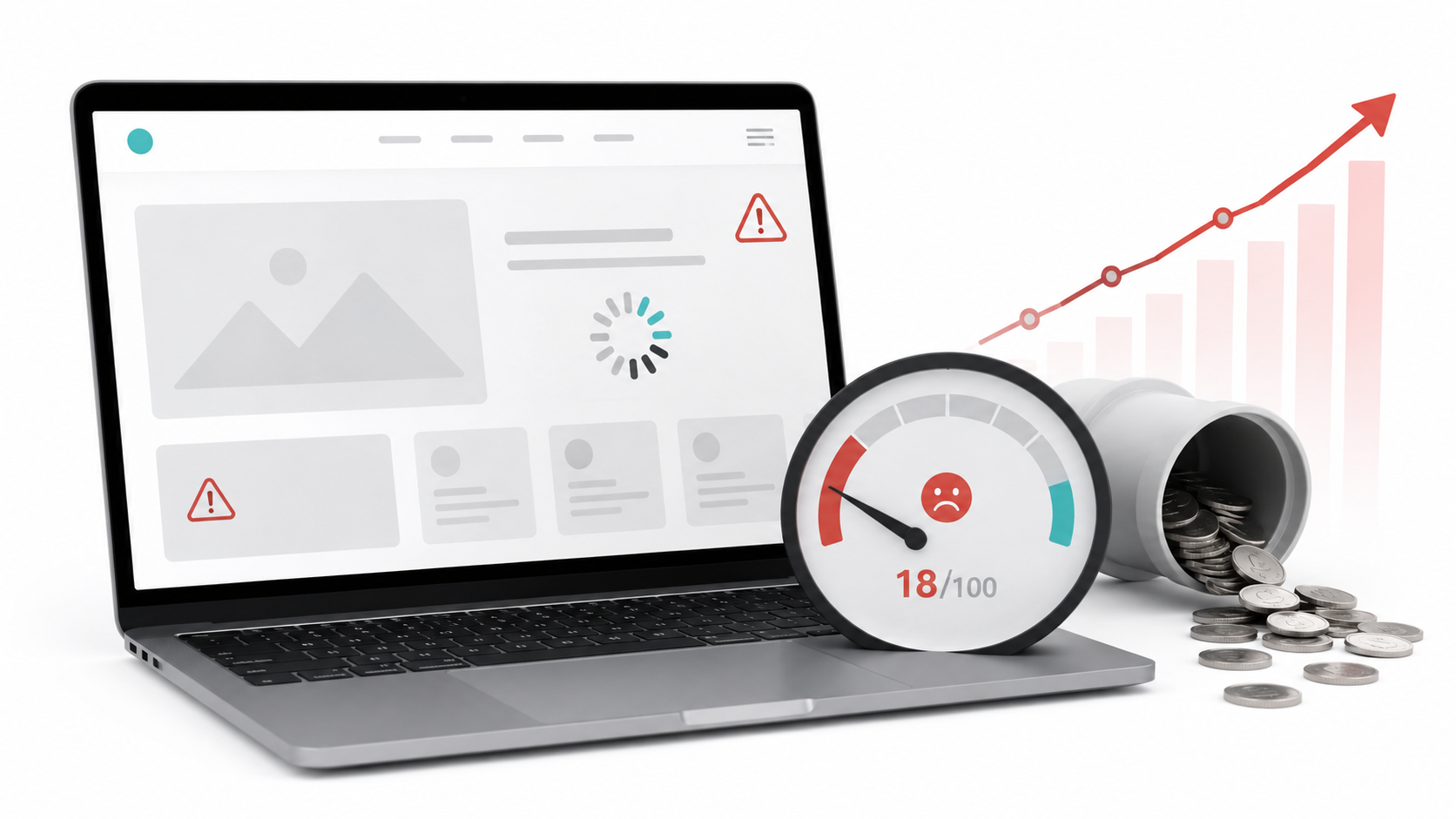
Google measures real-world page performance through Core Web Vitals, evaluating load speed, interactivity, and visual stability, and pages that score poorly rank lower in organic search while also receiving below-average landing page experience scores in Google Ads. Beyond the algorithmic impact, slow pages convert worse regardless of campaign quality. Research shows that a one-second delay in page load time can result in a 7 percent reduction in conversions, which on a paid campaign translates directly into a higher cost per lead with no change in budget. Our SEO and AEO services include technical audits covering all of these elements as part of a full-funnel optimization process.
Form Friction, Conversion Paths, and B2B Landing Page Best Practices
This is where a lot of B2B companies lose paid traffic they've already paid to generate. The ad was solid, the landing page looked fine, and the campaign was well-targeted, but the conversion path itself failed the buyers who were ready to take action. Understanding where friction lives in your conversion flow and removing it systematically is one of the fastest ways to improve paid media ROI without increasing spend.
How many steps does it take to convert?
The number of steps between clicking your ad and completing a conversion is one of the most impactful and most overlooked variables in paid performance. If it takes more than three steps, you're creating drop-off at every single one, and multi-page forms, account creation gates, lengthy qualification questionnaires, and third-party booking redirects all add to that count. A buyer who abandoned your form at step four didn't change their mind about your product; the process itself failed them, and that's a paid media problem with a website solution. Our creative messaging and CRO services address conversion path design as part of every engagement.
The form field problem
Following B2B landing page best practices means keeping your conversion forms lean. Asking for phone number, company revenue, team size, and tech stack before establishing any value with a prospect pushes qualified buyers away from forms they were ready to complete. High-performing B2B demo request forms typically ask for four to six fields, with everything else collected through the sales conversation once the lead is already in the funnel. Every field you remove is a measurable improvement in conversion rate, which on a paid campaign means a lower cost per lead without changing a single bid or creative.
Message match
When someone clicks an ad promising a specific outcome and lands on a generic homepage or a page with different messaging, the disconnect is immediate and usually fatal to the conversion. Your ad and your landing page need to share the same value proposition, the same language, and the same call to action, which means a paid ad for B2B demand generation should go to a page specifically about demand generation rather than a general services overview. When message match is tight, both conversion rates and Quality Score improve, and the campaign becomes more efficient without any changes to the campaign itself.
The Engagement Signal Feedback Loop
Most paid media teams don't see this problem until the costs have already climbed and the fix is harder than it needed to be. Google uses on-site engagement signals from your paid traffic to continuously inform future campaign quality, which means every high bounce rate, every short session, and every low pages-per-session reading feeds back into your landing page experience score and raises what you pay in subsequent auctions.
The compounding problem
The loop works like this: a weak website generates high bounce rates from paid traffic, which lower Quality Score, which raises CPC, which means less traffic for the same budget, which means fewer conversions, all while the root cause stays uninvestigated. Fixing the website doesn't just reduce CPC as a one-time improvement. It breaks a feedback cycle that may have been compounding costs for months. Our analytics and reporting team regularly finds, when auditing new accounts, that this compounding effect is significantly larger in dollar terms than clients expected.
Retargeting pool pollution
When your website consistently bounces paid traffic, your retargeting audiences gradually fill up with visitors who were never going to convert, and you end up spending retargeting budget re-engaging people who clicked an ad and left within seconds. The problem isn't the retargeting strategy or the audience parameters. It's the upstream website experience that disqualified those visitors before you had a chance to nurture them. Our paid media management team addresses retargeting pool health as part of every full-funnel campaign review, not as a separate workstream.
How to Audit Your Website Before Scaling Paid Spend
Before increasing your paid media budget, it's worth running through this checklist. Each item is a direct connection between website health and paid media efficiency, and most can be assessed in a single afternoon with access to Google Ads, Google Search Console, and a browser. If you find issues across multiple areas, our analytics and reporting team can help you understand where the biggest cost impact is and which fixes to prioritize first.
- Quality Score in Google Ads. Anything below 7 on core keywords warrants investigation into landing page experience and ad relevance.
- Core Web Vitals. Run a report in Google Search Console and fix poor-scoring pages before driving more paid traffic to them.
- Conversion path step count. From ad click to form submission, more than three steps means something should be removed.
- Form field count. More than six fields on a demo or contact form is a conversion drag. Reduce and test the impact.
- AI search visibility. Search your brand and category in ChatGPT and Perplexity. Not appearing in relevant answers signals an AEO gap worth addressing before scaling spend.
- Crawl and indexing errors. Check Google Search Console for unresolved errors. Unindexed pages carry no authority and can't support paid performance.
- Message match. Read your ad copy, then your landing page. If the value proposition shifts between them, fix it before scaling.
Fix the Foundation. Then Scale.
Paid media amplifies what's already there. A strong website with solid SEO and AEO, fast load times, and a clean conversion path gets amplified by every dollar you put into paid campaigns. A weak website gets exposed by that same investment, and the more you spend, the wider the gap becomes between what you're paying and what you're getting.
The highest-leverage move in B2B performance marketing isn't adding budget to a struggling campaign. It's building the foundation that makes paid budget work at its full potential. A strong B2B paid media strategy isn't just about what you spend on ads. It's about making sure the website, the SEO, the AEO, and the conversion experience are all pulling in the same direction. Our demand generation strategy team works across paid, organic, and technical foundations to make sure every part of the system is aligned and compounding.
Ready to Speak With a Blackbird Expert?
If your paid campaigns are underperforming, the answer may not be in the bids or the creative. It's often in the foundation underneath them. The Blackbird team brings paid media, SEO and AEO, creative and CRO, analytics, and design under one roof, which means we see these full-funnel dynamics play out every day. We've earned back-to-back PPC for B2B honors because we treat paid media and website performance as part of the same system, not separate disciplines.
If you're running paid campaigns and haven't fully examined how your website is affecting them, there's a good chance you're paying more per lead than you need to. Speak with one of our experts and get a clear picture of where the gaps are. We'd love to hear what you're working on.
Contact UsFrequently Asked Questions
Does my website quality actually affect my Google Ads cost?
Yes, and the impact is significant. Google Ads assigns a Quality Score to every keyword in your account, and one of the three components is landing page experience, evaluated on relevance, speed, and usability. Research shows that accounts with scores of 8 or above pay CPCs 37 percent below the industry median, while accounts with scores of 4 or below pay 64 percent more. A strong landing page experience lowers CPC, improves Ad Rank, and makes every dollar you spend on paid search go further.
What is AEO and how is it different from SEO?
SEO (search engine optimization) focuses on ranking in traditional search results. AEO (answer engine optimization) focuses on being cited as a direct answer by AI tools including ChatGPT, Perplexity, and Google AI Overviews. Where SEO earns a link in the results, AEO earns a mention in the answer itself. Both matter for B2B SaaS companies, and their technical foundations overlap significantly, which is why they work best when built together as part of a unified strategy.
How do I know if my website is hurting my paid media performance?
Key signals include a Google Ads Quality Score below 7 on core keywords, high bounce rates on paid landing pages, conversion rates below industry benchmarks, poor Core Web Vitals scores in Google Search Console, and absence from AI search results for topics relevant to your category. If you're seeing multiple signals at the same time, the website is almost certainly contributing to the underperformance, and it's worth investigating before adding more budget to the campaigns.
What is a good Quality Score in Google Ads?
A score of 7 or above is considered strong, with scores of 8 to 10 indicating well-aligned ads and landing pages that Google rewards with lower CPCs and better placement. Scores below 5 are a clear signal that landing page experience or ad relevance needs attention, and if your core keywords are at 4 or lower, the cost impact is likely significant. Even moving a high-volume keyword from a 5 to a 7 can produce meaningful monthly savings at scale.
How do I rank in Google AI Overviews?
Create structured content that directly answers common buyer questions in clear, plain language, and implement schema markup on key pages including FAQ schema. Develop authoritative content across your core topics and use internal linking to demonstrate topical depth and expertise. Strong backlinks and consistent brand mentions on trusted, relevant sites also contribute to AI citation visibility. For a deeper look at how to build for both traditional and AI search simultaneously, our SEO and AEO page outlines our approach.
How does page speed affect paid advertising?
Slow pages increase bounce rate, hurt Quality Score in Google Ads, and directly reduce conversion rates. Research shows that a one-second delay in load time can reduce conversions by around 7 percent, which in a paid campaign context means slower pages produce fewer leads per dollar spent regardless of how well the campaign is optimized. Page speed is also a Google ranking factor, which means it affects both your organic authority and the quality signals your paid landing pages send. Addressing it before scaling paid spend is one of the fastest efficiency improvements available.
What is the relationship between SEO and paid search?
They're far more connected than most B2B teams realize. Organic rankings build buyer trust before conversion, protect against competitors bidding on your brand terms, and create double listings that lift click-through rate when you rank for the same keyword you're bidding on. Strong SEO also signals to Google that your site is a credible, relevant destination, which feeds directly into Quality Score. Treating them as completely separate disciplines is one of the most common and costly mistakes in B2B paid media, and it's one of the first things we look at when reviewing a new account. You can learn more about how we approach both on our SEO and AEO services page.
