
1PD for Paid Media: A Quick How-To Guide
“Measure what compounds. Spend where it does.” In today’s marketing landscape, that’s an imperative.
Paid media has entered a new era defined by signal loss, attribution drift, and rising financial scrutiny. The old playbook of optimizing to platform-reported conversions and last-click ROAS is breaking down, and most marketing teams know it. What’s less clear is what should replace it.
At Blackbird, we’ve won industry awards by building and leveraging a measurement stack on the only durable asset marketers still control: first-party data. That was the focus of my presentation at SMX Advanced in early June, and it’s what I’ll explain in this post.
Why the Shift Is Non-Negotiable
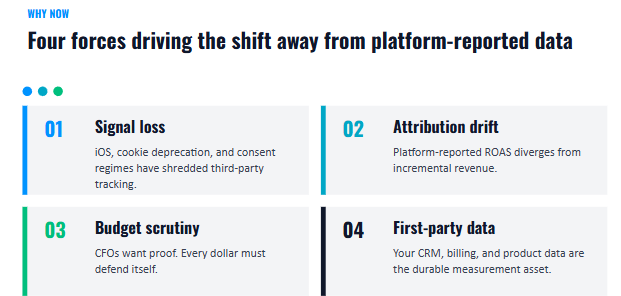
Four forces are converging to make traditional paid media measurement untenable.
Signal loss. iOS privacy changes, cookie deprecation, and consent regimes have shredded third-party tracking. Increasingly, platform conversions are modeled, not observed.
Attribution drift. Last-click attribution (which by now every marketer knows is highly flawed) diverges wildly from reality. In branded search alone, platform-reported ROAS can overstate incremental revenue by 30–60%.
Budget scrutiny. CFOs are no longer satisfied with platform data. Marketing dollars must defend themselves in quarterly reviews with evidence that ties to revenue, not proxies.
First-party data has emerged as the stable ground. Your CRM, billing, and product data survive every platform change. They tell the truth when platforms can’t.
This shift requires rethinking what we optimize, how we allocate budget, and how we prove impact. Three measurement ideals form the foundation.
1. Stop Bidding on Conversions. Start Bidding on Customers.
Most paid media programs still optimize to CPA, and that’s a big problem.
A flat CPA target treats every conversion as equal even though customer value is anything but. In most businesses, a small minority of customers generate the majority of lifetime revenue. (Remember Pareto’s Law: roughly 20% of customers drive 80% of value.)
Two customers acquired at the same $42 CPA can deliver wildly different outcomes—one becoming a high-frequency, high-margin buyer, the other never purchasing again. The platform can’t see that difference unless you tell it.
Customer Lifetime Value (CLV) reframes paid media as customer acquisition, not transaction acquisition. It aligns bidding with the customer you actually want.
This doesn’t require a perfect crystal ball. Use a practical framework like RFM scoring (Recency, Frequency, Monetary value), which lets you segment customers using data already in your CRM.

From there, you can define action-oriented segments: Scale high-value champions, nurture new and potential buyers, and win back customers at risk.
For more sophistication, clustering methods (k-means, GMM, hierarchical models) uncover natural groupings beyond simple rules.
Ultimately, CLV becomes a number you can bid against:
CLV = AOV × Purchase Frequency × Gross Margin × Customer Lifespan
This single shift—sending value back to platforms instead of binary conversions—changes who the algorithms find and how your spend compounds over time.
2. Reconstruct the Truth with Marketing Mix Modeling
Even with better bidding, attribution alone can’t answer the hardest questions in paid media.
Platforms systematically miss:
Above-the-line channels like TV, podcasts, and OOH
Baseline demand that would have converted anyway
Saturation and diminishing returns
Cross-channel halo effects (e.g., TV lifting search, social lifting direct)
Marketing Mix Modeling (MMM) addresses this by using your own time-series data (media spend, sales, promotions, and seasonality) to estimate each channel’s marginal contribution without the need for pixels or platform permissions.
At its core, MMM decomposes total sales into:
Baseline demand
Incremental contribution by channel
Carryover effects and diminishing returns
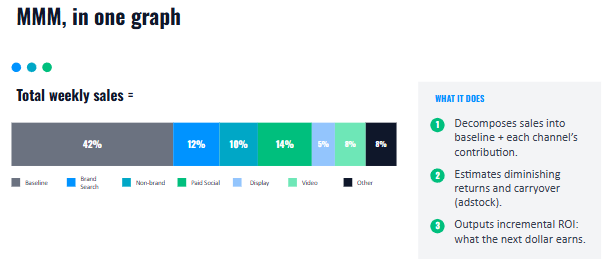
What matters isn’t average ROI (what worked historically), but marginal ROI, simply expressed as what the next dollar in each channel will earn. That’s what guides defensible budget reallocation.
Modern MMM isn’t theoretical or inaccessible. Open-source frameworks like Meta’s Robyn and Google’s Meridian have made robust modeling achievable for in-house teams and agencies alike. The input requirements are straightforward: weekly spend, first-party revenue, and enough historical data to observe patterns.
Run it quarterly. Treat it as a planning tool, not a post-mortem.
3. Use incrementality testing as measurement proof
Attribution estimates. MMM estimates. Incrementality tests measure.
Across published studies, 30–60% of “attributed” conversions would have happened anyway. The only way to know what media truly caused is to remove exposure and observe the difference.
Incrementality testing is causal by design:
Test groups receive media.
Control groups do not.
The delta is net new impact.
Different channels require different designs:
Geo holdouts for brand, CTV, and OOH
Audience holdouts for paid social and display
Time-based on/off tests for channels like branded search
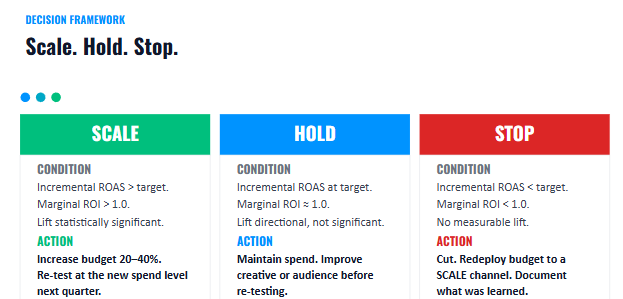
Well-designed tests validate your entire measurement stack and lead to decisions like:
Scale channels with significant lift and marginal ROI above 1
Hold where performance is directional but not proven
Stop where no measurable impact exists and redeploy with confidence
Wrapping up
First-party data is truly the only measurement asset you control.
Three principles to take forward:
Bid on CLV, not CPA. Tell platforms what customers are worth.
Run MMM regularly. Your own time series is the ground truth.
Test before you trust. Incrementality is how decisions survive scrutiny. Start with incrementality, and cycle in MMM analyses at regular intervals for further calibration, since measurement is never one-and-done.
With the right measurement foundation, you can make your paid media budgets work more effectively, even as automation continues its takeover.