Why Slow Creative Testing Costs You & How to Accelerate It
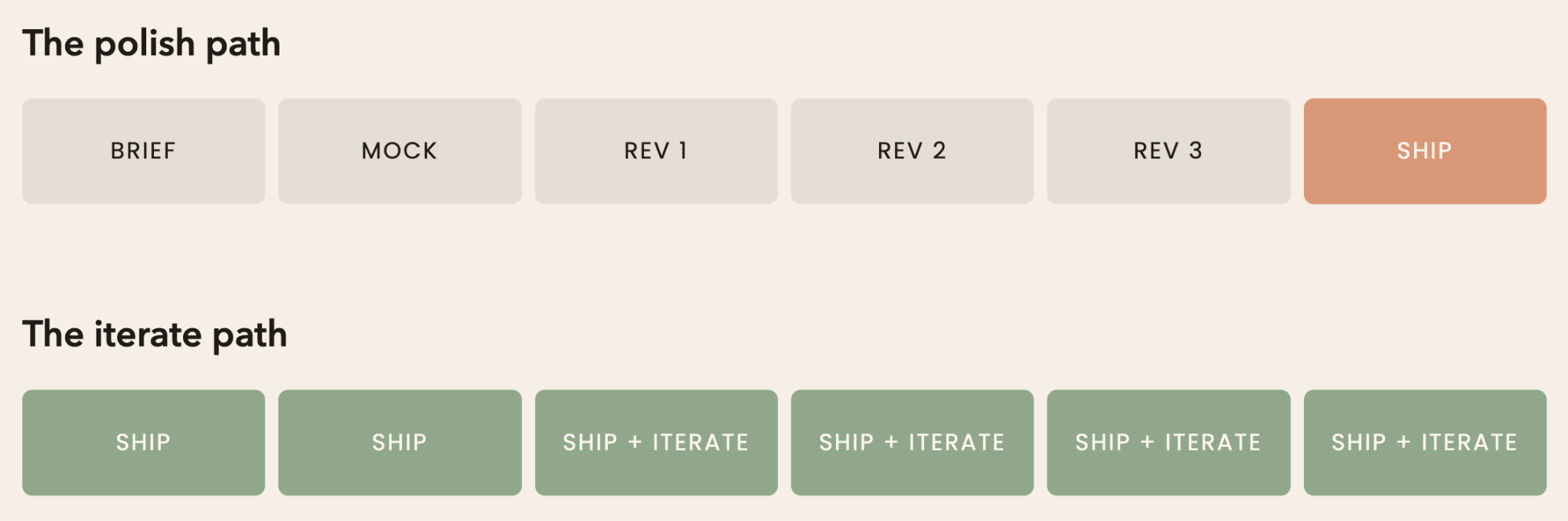
A client briefs you about a new asset. The next steps are usually brainstorming, creating mockups, getting feedback, making changes, and shipping the final version. By the time it passes every internal review and actually goes live, six weeks have flown by. The asset might’ve been timely when it was first briefed, but now? It’s likely out of date.
This is the big struggle with creative testing. The steps you take to make sure the creatives are “up to the standard” or“on-brand” are often the same ones that hurt performance. The cost of this delay rarely shows up in any reports. And worse, slow creative cycles compound over time. Every week you don’t test or refresh creatives, you gain fewer learnings, and assumptions start running your ad account instead of the data.
Why Creative Testing Is Actually the Game
There's a common misconception in paid media that creative is something you sort out once targeting and budget are locked in. Build a few good ads, launch them, optimize from there. But in practice, creative is where most of the performance difference actually lives.
Targeting helps us find the right people, but creative is what makes them actually care about your brand.
Let’s take Meta as an example. We have seen that Meta doesn’t really reward launching one great ad and calling it done. The platform rewards cycling through enough creatives to find the “supernova ad” (which is the Blackbird term for a creative that really catches fire). The algorithm identifies and pushes hard on this creative because audiences are responding to it more than any other. You can only create the conditions for one by feeding the platform enough variety.
Almost all algorithm-based bidding on Meta, LinkedIn, and other social platforms naturally cuts poor performers and pushes more spend and impressions toward ads with higher CTR and engagement. The algorithm is always rooting for your best creative. However, slow creative cycles mean fewer ads in the running, and a smaller chance of finding that supernova.
We ran a packaging test for a consumer brand comparing an older product design against a sleeker new one. The intuitive assumption was that the new packaging would win. But when we let the test run long enough to reach statistical significance, the old packaging won with 83% confidence level over the new version. No internal review process could catch this, but the data showed what the audience preferred.
You can have good hypotheses and polished ads, but you only know what actually works when it's in the market and you see the data.
Three Ways Slow Creative Cycles Cost You Money
1. You’re Missing Out on Learning
The biggest cost of a long approval loop is the data you didn't get to collect. Every week an ad isn't live is a week you aren't learning which angle resonates, which persona converts, or what your CPL benchmark for this offer actually is.
We saw this recently with a client, where it took a whole month to get the first round of mockups live. If we had launched a "good enough" version in week one and iterated weekly, we would have run four learning cycles in the same span. Waiting for the “perfect version” only slowed us down.
2. You’re Burning Your Budget
Launch dates are flexible, but monthly budgets usually aren’t. You often either end up underpacing or keep pushing spend into whatever old creative that’s currently live (likely the stuff that you were trying to replace in the first place).
Let’s say you have a $25K monthly budget on LinkedIn. A 2-week delay means you just spent $12K on ads you already knew weren't performing. You still spent the money, but you didn't get nearly as much value out of it.
3. Your Context Is Stale
A new offer is often a response to something, like a product launch, a competitor move, a conference, a new AI capability, a new trend, or an industry shift. By the time the ads roll out after approvals, the context has shifted. The competitor has launched their version, and the “new” thing is old news.
This is especially a bottleneck for event-based plays, competitor disruption campaigns, and End-of-Quarter pushes, where timing is literally the strategy.
How to Fix the Creative Gap (Bottlenecks)
Here are five patterns that actually work:
1. Get Quick Approvals with "Tiered" Approvals Based on Spend
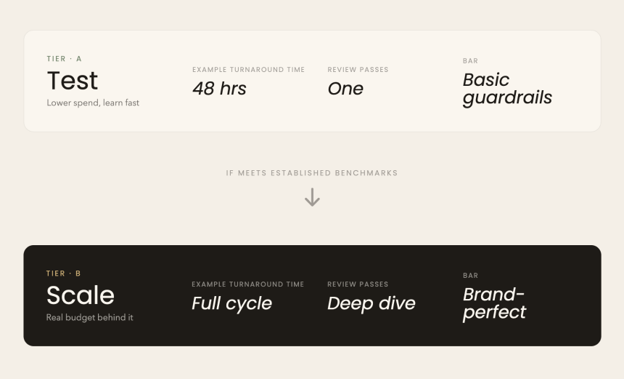
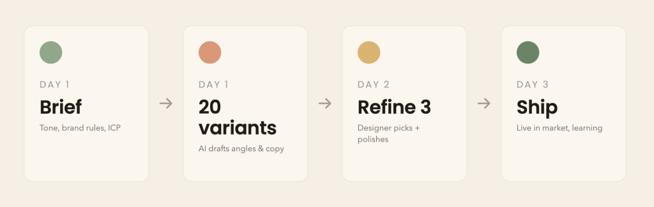
Not every ad needs the same level of scrutiny and brand review. Test-tier ads get a quick turnaround - say 2 days, with one review pass and basic guardrails. Once these ads meet a certain performance benchmark, they can be further iterated on to scale. Scale-tier ads are anything that has shown historical traction that you plan to put real budget behind. These get the full, deep-dive review.
It’s also worth noting: if your team has a deep, shared understanding of your product, positioning, and overarching messaging, approvals shouldn't take long in the first place. When everyone is aligned on what the brand stands for and what it's trying to say, a review becomes a quick gut check. Long approval cycles are often a symptom of unclear positioning, not just a slow process.
2. Create a "Pre-Approved" Creative Kit
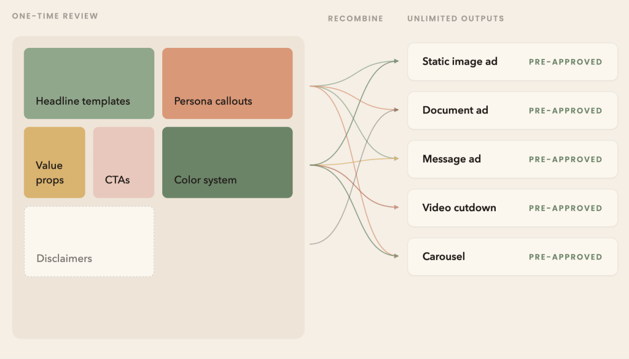
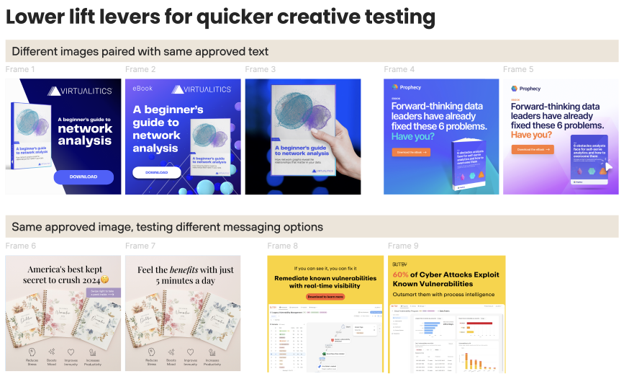
Instead of reviewing every new ad from scratch, get a kit reviewed once. A good kit includes pre-cleared headline templates, persona callouts ("security team is seeing X" or "fleet managers are facing Y"), value props, CTAs, color systems, and disclaimers.
Once you have a pre-approved kit, you can recombine its elements into new ads without restarting the review process. This can unlock lots of variety: the same kit can produce a static image ad, a document ad, a message ad, all from one single approval cycle.
This also has a compounding benefit. As the kit grows over time with more approved components, the surface area you can cover without triggering a new review gets wider.
Examples:
3. Pick the Right Format
Some ad formats are inherently faster to approve because they have fewer brand surfaces to review.
LinkedIn Document ads: These ads just use the already-published offer PDF that has already been signed off on. You aren't creating new brand surfaces that need review or approvals. We have also seen these ads perform better than our image ads recently for some of our clients.
InMail and message ads: Plain text body, one CTA, and a relevant sender are all you need for these ads. For time-sensitive ABM efforts, this is often a quick format to ship.
Custom-illustrated single-image & video ads: New imagery, new layouts, new persona depictions - all need brand approval and take more time to launch. These ads typically take the longest. Save them for evergreen campaigns where the asset will run for months, and the upfront investment in review amortizes.
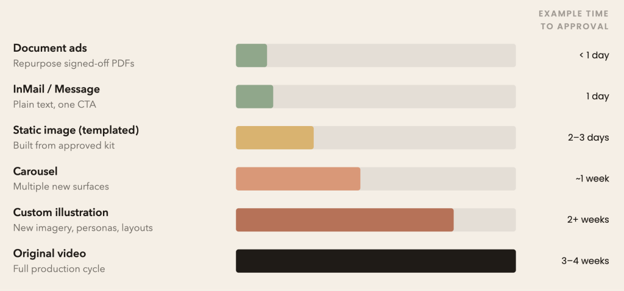
The main takeaway: when testing velocity matters most (responding to a competitor move, capitalizing on a report, supporting a launch window), try to prioritize formats with shorter review surfaces.
4. Build a Standing Review Cadence
Don’t let your creative assets languish in an inbox graveyard. Reserve a standing review slot on the calendar with the brand/creative team (weekly or biweekly), so the creative never sits in a queue. When a brand/creative team knows there's a Tuesday review slot every week, they can prepare for it. Predictability compresses timelines more reliably than pressure ever does.
This also makes the whole process feel less like an "emergency" and more like a normal part of everyone’s workflow.
5. Buddy up with AI
AI is a fantastic creative partner, but only if you use it right. Instead of just asking it to "make an ad," use it to accelerate the early, messy stages of iteration: generating a range of headline angles, drafting persona-specific callout variants, and producing fast rough mockups to brainstorm internally before briefing a designer.
We've also had great success setting up custom AI agents fed with specific brand guidelines. It makes churning out on-brand ideas faster than ever. Give it your brand tone, the do’s and don’ts, the colors, typography, and branding, and play around with it!
The Bottom Line
That "perfect" version that finally ships in week six is mostly built on guesses. A "good enough" ad that's been in market for three weeks gives you real data about what's actually resonating. That data makes the next version better than any pre-launch review ever could.
This is why creative testing is the game, not just “nice-to-have.” The brands that improve most over time are the ones that consistently experiment, instead of the ones with the most beautiful ads.