
B2B Messaging: Why It’s So Tricky and What to Do About It
Pull up the websites of five competing B2B companies in any category, and you’ll find the same phrases: “AI-powered.” “Real-time.” “Unified platform.” “Trusted by leading enterprises.” Each of those companies typically has a genuinely different product solving a real problem, but you wouldn’t know it from the way they describe themselves.
This is a positioning problem, and we run into it constantly with our clients. When positioning is clear and specific, everything downstream (content, campaigns, sales conversations) gets much easier. But when it’s vague, you can optimize your programs all you want and still hit a ceiling because your ideal customers can’t understand why your product or service is the best choice to address their specific needs.
Why Messaging Converges
There are a few structural reasons companies end up with generic messaging. The most common is that messaging gets reviewed into blandness. When a positioning statement passes through product, marketing, legal, sales, and leadership, each round of feedback can pull out whatever feels too specific or too bold. Everyone is protecting something legitimate, but the cumulative effect is something broad enough to say nothing in particular.
Competitor mirroring is another factor. When you’re building messaging from scratch, it’s natural to use established players as a reference point. When everyone does this, the whole category converges toward the same vocabulary without anyone making a deliberate choice to sound like their competitors.
Another potential culprit: a target audience defined too broadly. “IT decision-makers at mid-market companies” is a category, not a person. With such a wide audience, you end up with messaging that’s technically relevant to everyone but doesn’t resonate strongly with anyone.
What Suboptimal Messaging Does to Your Marketing Program
You’d think unclear positioning would just affect brand guidelines or website copy, but it tends to show up everywhere. Content ends up generic enough that any competitor could have published it. Demand generation campaigns attract leads that look right on paper but don’t convert, because the message brought in people who were vaguely interested rather than specifically motivated.
We did a recent audit for a company providing fleet safety technology; in that industry, nearly every major player leads with AI-powered cameras, real-time alerts, and lower insurance costs. Our client had real product differentiation – a different AI architecture leading to stronger driver-scoring data – but none of it was showing up in the marketing because it hadn’t been translated into distinct angles the team could use. The work was to map where competitors were clustering and find the angles nobody owned clearly: driver coaching outcomes, insurance ROI, distracted driving as a specific use case. Each speaks to a different buyer, and mapping that out gave the team something real to build from.
The Repositioning Loop and Why It’s Worth Avoiding
One response to unclear messaging is to try to fix it by repositioning frequently, cycling through different frames until something clicks. This is worth talking about because it has its own costs that aren’t always obvious in the moment.
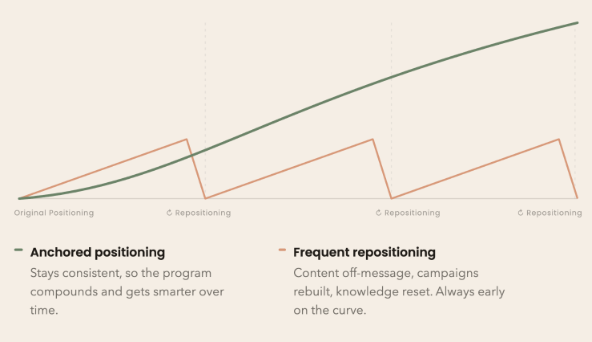
We worked with a data engineering platform that went through three distinct positioning shifts in less than 18 months. They started as a legacy solution replacement, then shifted to “modern solution” positioning, then finally landed on “Copilot” positioning. Each move made sense at the time, and none of them was a bad idea on its own. But every time the positioning changed, the existing marketing program became obsolete. Content was suddenly off-message, campaigns had to be rebuilt, and the knowledge we had built up about what resonated with which buyers got reset. We were effectively starting from zero every few months.
The underlying challenge was that the company hadn’t established stable core positioning that could flex across different messages without requiring a full rebuild each time. Marketing programs that stay anchored to a consistent message get smarter over time; in contrast, frequent repositioning means you’re always in the early stages of the learning curve.
What It Looks Like When the Work Gets Done
A security company came to us with an actual positioning document with a real statement defining who they’re for, the specific problem they solve, how they solve it differently than their competitors, and proof points for each value proposition. They had a category name they owned and a real point of view about why it mattered.
Not every piece translated directly into a campaign, but having the foundation made every downstream decision faster. Briefing designers, building campaigns, onboarding sales reps – all of that is easier when there’s a clear point of view to work from.
Another client figured out that persona-specific messaging consistently outperformed generic product messaging. Their strongest approach called out the buyer’s role directly and anchored it to a real pain point. The first iteration started with a vague callout of “security teams,” but as we iterated more, we got more specific. We tested calling out situations and details like “you're a senior analyst”, “your security team is outnumbered”, or “you're being asked to do more with the same people.” With such granularity, paired with the right targeting, we saw lead quality improve noticeably. This level of specificity is only possible when you know your buyer well enough to describe their situation back to them accurately.
Where to Start
Audit first, action later
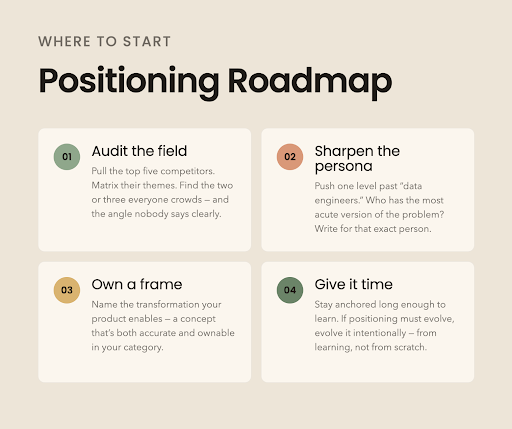
The first thing we usually recommend is doing a competitive messaging audit. The exercise is simpler than it sounds: pull the top five or so competitors in your space, look at how they describe themselves on their websites and in their ads, and build a simple matrix of what themes and pain points each one is leading with.
What you’re looking for are the two or three themes that everyone is crowding around, and then the angles that nobody is saying clearly. That gap tends to be where the most meaningful differentiation lives – assuming it’s an angle you can authentically claim for your brand – and it’s something you genuinely can’t see without doing the comparison.
Identify your target persona
The other thing that makes a consistent difference is getting more specific about who you’re writing for (which every marketer should instinctively know but often gets skipped at the messaging stage). If your target persona is defined at the level of “security leaders” or “data engineers at enterprise companies,” try pushing one level deeper.
What is the specific version of this person who has the most acute version of the problem you solve? What does their situation look like day-to-day? What’s the conversation they’re having with their leadership? When you write for that specific person, the message tends to land better with the broader audience too, because specificity reads as understanding.
It also helps to build out a simple messaging matrix across your key personas and use cases. Most B2B products solve genuinely different problems for different types of buyers, and having those mapped out explicitly gives you a foundation that the whole team can work from. The primary pain point for each persona, the differentiated way your product addresses it, and the proof point that makes the claim credible end up being useful in more places than you’d expect: content planning, campaign strategy, sales enablement, creative briefing, etc.
Framing is the name of the game
One thing that’s harder to put into action but worth thinking about is whether there’s a concept or a frame you can genuinely own in your category.
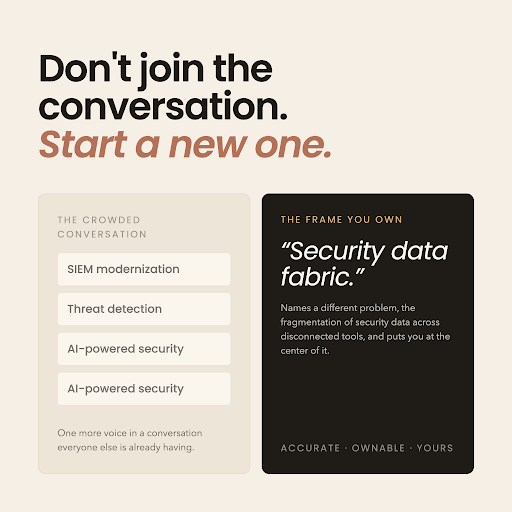
Some of the strongest B2B positioning we’ve seen is built around a concept that puts the company at the center of a specific conversation rather than participating in one that everyone else is already having. One of the clearest examples we've seen of this is a security analytics company that built its positioning around the term "security data fabric," a frame that most players in this category weren't using. Instead of joining the crowded conversation around SIEM modernization and threat detection, they named a different problem: the fragmentation of security data across disconnected tools.
That unique frame gave them something to own. Finding wording that frames your product as a reference point requires going beyond features and asking what the transformation is that the product enables, and whether there’s a way to name that transformation that’s both accurate and ownable.
Give it time
Finally, once you have something that feels right, the most important thing is to give it time to work. The companies that get the most out of their marketing programs are the ones that stay anchored to a consistent positioning long enough to actually learn from it. You figure out what resonates, you build on it, and the program compounds over time. If the positioning needs to evolve, evolve it intentionally.
The goal is to update from a position of learning instead of restarting from scratch every time the strategy conversation takes a new turn.
Final Thoughts
A lot of things in B2B marketing are hard to control: attribution is complicated, buyer cycles are long, buying committees are complex, and budgets are rarely as big as required to meet revenue goals. But positioning is something you can actually work on, and the returns tend to show up across every action taken on top of it.
The companies that consistently outperform their category are usually the ones that figured out something specific and true to say and built their programs around communicating that well.